
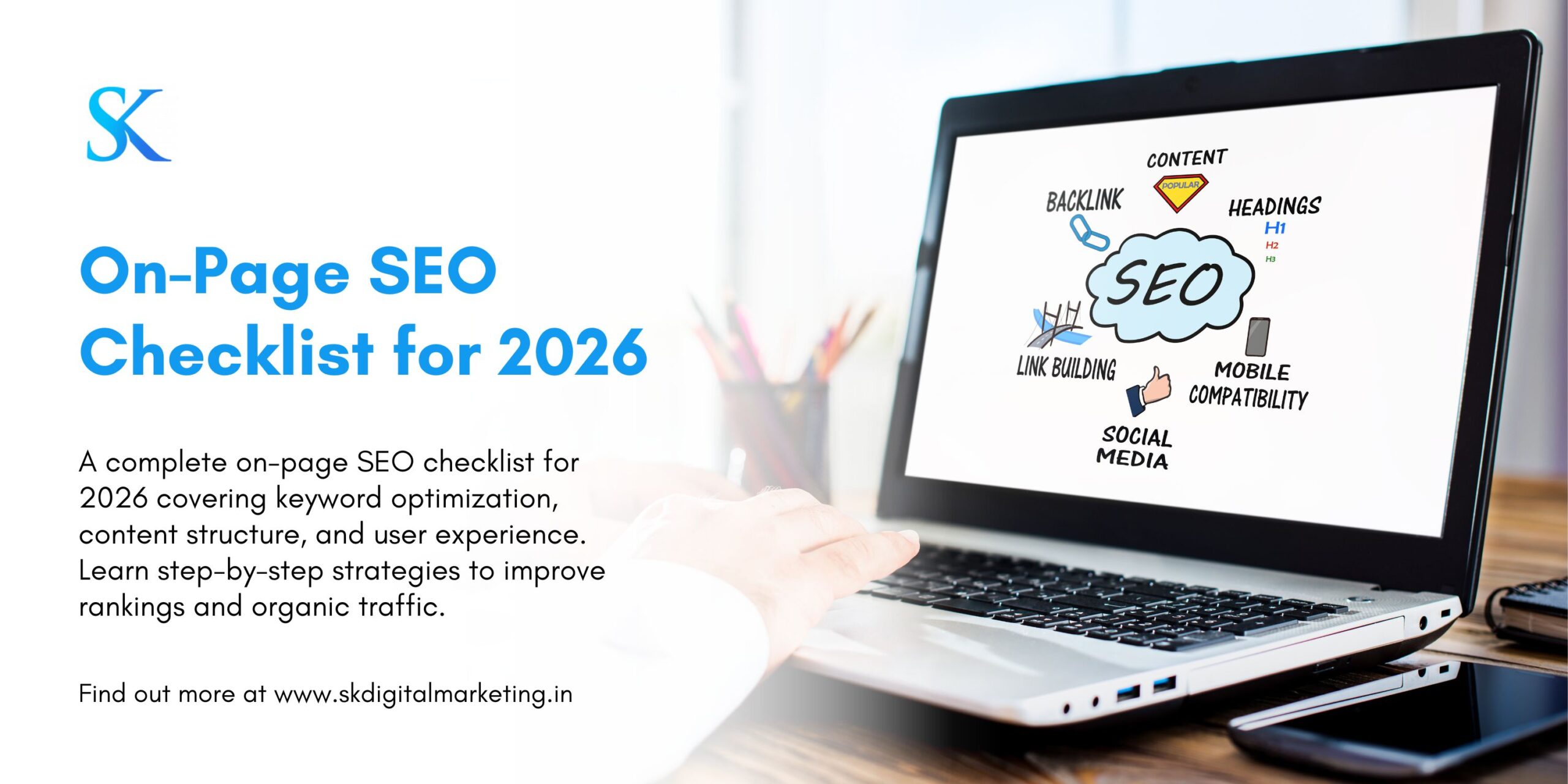
On-page SEO remains one of the most important factors for ranking higher on Google in 2026. With AI-driven search, user experience signals, and semantic search becoming more powerful, optimizing your website correctly is no longer optional—it’s essential.
This step-by-step on-page SEO checklist will help you optimize every webpage for better rankings, traffic, and conversions.
Step 1: Keyword Research & Search Intent
Before creating or optimizing content, understand what users are searching for and why.
✔ Actions:
- Choose one primary keyword per page
- Add 2–5 secondary keywords (LSI/semantic keywords)
- Analyze search intent:
- Informational
- Navigational
- Commercial
- Transactional
- Check top-ranking pages to understand content format
✔ Tools:
Google Keyword Planner, Ahrefs, SEMrush, Google Search Console
Step 2: Optimize Title Tag (Most Important)
Title tags strongly influence rankings and click-through rates.
✔ Best Practices:
- Keep title length between 50–60 characters
- Include the primary keyword at the beginning
- Make it compelling and clickable
- Avoid keyword stuffing
Example:
👉 Complete On-Page SEO Checklist for 2026 – Step-by-Step Guide
Step 3: Write an Engaging Meta Description
While meta descriptions don’t directly affect rankings, they improve CTR.
✔ Best Practices:
- Length: 150–160 characters
- Include the primary keyword naturally
- Add a call-to-action (CTA)
Example:
👉 Learn the complete on-page SEO checklist for 2026. Step-by-step guide to optimize content, keywords, UX, and rankings.
Step 4: SEO-Friendly URL Structure
URLs should be simple, readable, and keyword-rich.
✔ Best Practices:
- Use lowercase letters
- Include the primary keyword
- Avoid unnecessary numbers or symbols
Example:
👉 /on-page-seo-checklist-2026/
Step 5: High-Quality, Helpful Content (E-E-A-T Focus)
Google now prioritizes Experience, Expertise, Authoritativeness, and Trustworthiness (E-E-A-T).
✔ Content Guidelines:
- Solve the user’s problem completely
- Use original insights and examples
- Keep content updated for 2026 trends
- Avoid AI-only or thin content
- Add FAQs, bullet points, and examples
✔ Ideal Length:
- Informational pages: 1200–2000+ words
- Service pages: 800–1200 words
Step 6: Proper Heading Structure (H1–H6)
Headings improve readability and SEO.
✔ Best Practices:
- Use one H1 per page
- Include the primary keyword in H1
- Use H2 and H3 for subtopics
- Maintain logical hierarchy
Step 7: Image Optimization
Optimized images improve page speed and visibility in image search.
✔ Checklist:
- Compress images (WebP format preferred)
- Use descriptive file names
- Add keyword-rich ALT text
- Lazy load images
Example ALT text:
👉 on-page SEO checklist for 2026
Step 8: Internal Linking Strategy
Internal links help Google understand your site structure.
✔ Best Practices:
- Link to relevant blog posts and pages
- Use descriptive anchor text
- Avoid over-optimization
- Add 3–6 internal links per page
Step 9: External Links (Authority Signals)
Outbound links improve credibility when used correctly.
✔ Best Practices:
- Link to high-authority sources
- Open links in a new tab
- Avoid linking to spammy websites
Step 10: Page Speed & Core Web Vitals
User experience is a ranking factor in 2026.
✔ Optimize:
- Largest Contentful Paint (LCP)
- First Input Delay (FID)
- Cumulative Layout Shift (CLS)
✔ Tools:
Google PageSpeed Insights, Lighthouse, GTmetrix
Step 11: Mobile Optimization (Mobile-First Indexing)
Google indexes your mobile version first.
✔ Checklist:
- Responsive design
- Fast loading on mobile
- Clickable buttons & readable text
- No intrusive pop-ups
Step 12: HTTPS & Security
Security builds trust and rankings.
✔ Requirements:
- SSL certificate (HTTPS)
- No mixed content warnings
- Secure forms & data
Step 13: Schema Markup (Structured Data)
Schema helps search engines understand your content better.
✔ Use Schema For:
- Blogs
- FAQs
- Reviews
- Services
- Products
Result: Rich snippets & better visibility in SERPs
Step 14: Optimize for Featured Snippets & AI Search
AI-driven search results are growing rapidly.
✔ Tips:
- Answer questions clearly
- Use bullet points and tables
- Add FAQ sections
- Use a conversational tone
Step 15: Content Freshness & Updates
Outdated content loses rankings.
✔ Actions:
- Update old stats and screenshots
- Add new sections for 2026 trends
- Improve internal linking
- Refresh meta titles/descriptions
Step 16: Track Performance & Improve
SEO is ongoing, not one-time.
✔ Monitor:
- Rankings
- Click-through rate (CTR)
- Bounce rate
- Conversion rate
✔ Tools:
Google Search Console, GA4, SEO tools
Final Thoughts
Following this Complete On-Page SEO Checklist for 2026 will help you:
✔ Rank higher on Google
✔ Improve user experience
✔ Increase organic traffic
✔ Stay ahead of algorithm updates
On-page SEO is the foundation of long-term SEO success. When combined with quality content and consistent optimization, results follow naturally.