
Search is changing rapidly. People are no longer relying only on traditional search results to find information. They are increasingly asking complete questions and expecting direct, conversational answers from search engines and AI-powered search experiences.
This shift has made Answer Engine Optimization (AEO) an important topic for digital marketers, alongside traditional Search Engine Optimization (SEO).
But what exactly is the difference between AEO and SEO? Is AEO replacing SEO? And how can businesses use both strategies to improve their online visibility?
The short answer is: AEO and SEO work best together.
Google’s current guidance makes this especially clear: SEO fundamentals remain important for visibility in AI-powered search experiences, including Google’s generative AI features.
What Is SEO?
Search Engine Optimization (SEO) is the process of improving a website and its content so that search engines can understand, index and potentially rank its pages for relevant searches.
Traditional SEO focuses on helping a website appear prominently in search results when users search for specific keywords or topics.
Some important areas of SEO include:
- Keyword research
- On-page SEO
- Technical SEO
- Internal linking
- Website structure
- Content optimization
- Page experience
- Link building and digital authority
- Image and video optimization
- Local SEO
For example, a digital marketing institute may create a page targeting the keyword “digital marketing course in Panchkula.” SEO helps optimize that page so that search engines can understand its relevance and potentially show it when someone searches for that term.
What Is AEO?
Answer Engine Optimization (AEO) refers to the practice of structuring and improving content so that it can effectively answer users’ questions in search experiences that provide direct or summarized answers.
Instead of focusing only on ranking a webpage for a keyword, AEO emphasizes providing clear, useful and direct answers to specific questions.
For example, instead of targeting only:
“digital marketing course”
an AEO-focused content strategy may address questions such as:
- What is digital marketing?
- Is digital marketing a good career?
- How long does it take to learn digital marketing?
- What skills are required for digital marketing?
- How much does a digital marketer earn?
- Which digital marketing course is best for beginners?
This approach aligns with how modern search experiences increasingly handle longer and more conversational queries.
It is important to note that AEO is not a separate replacement for Google’s core SEO system. Google currently describes AEO as a term used for work focused on visibility in AI search experiences and states that foundational SEO practices remain relevant.
AEO vs SEO: Key Difference
The simplest way to understand the difference is:
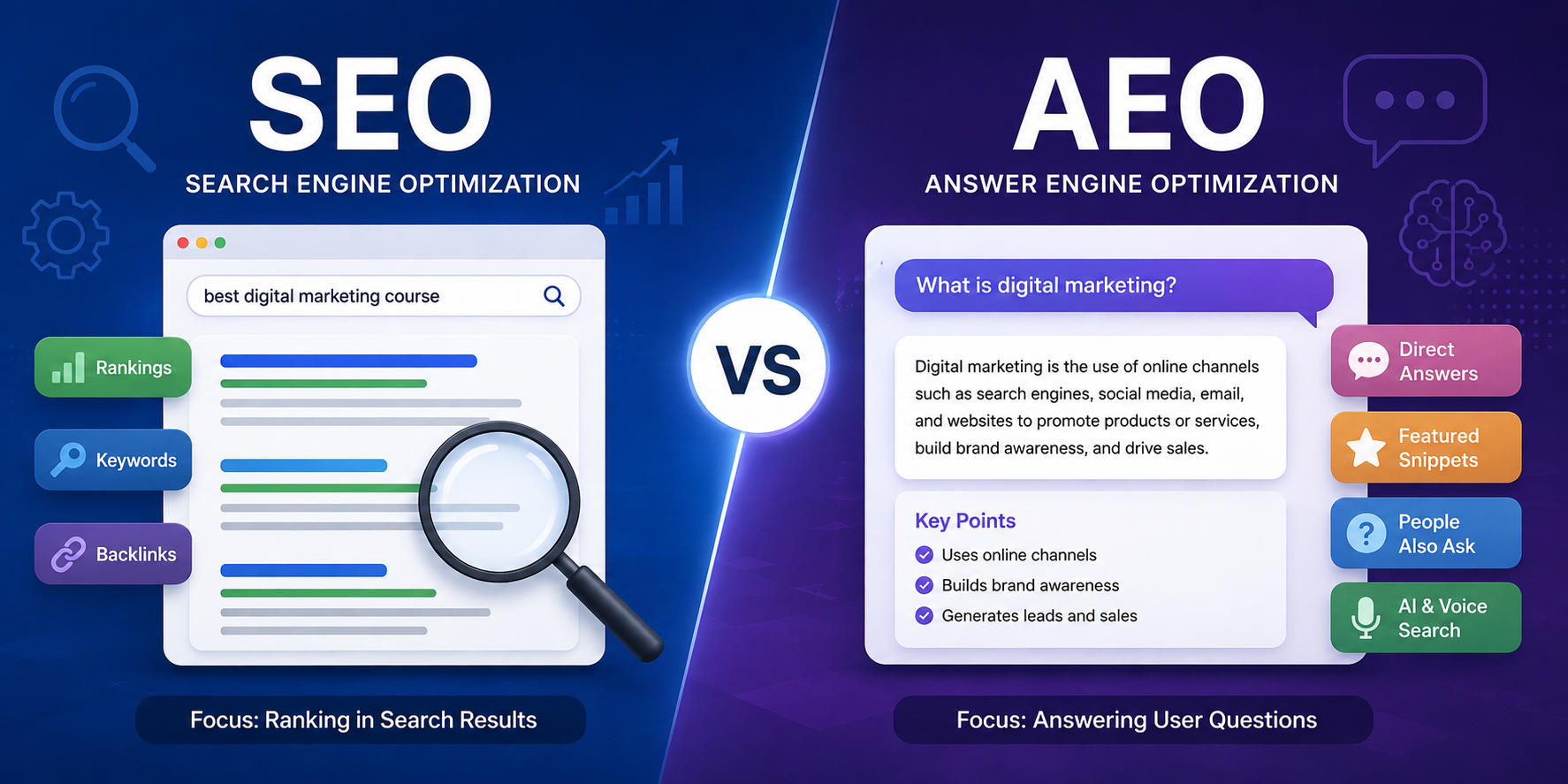
SEO focuses on improving visibility in search results, while AEO focuses more specifically on making content useful and understandable as a direct answer to a user’s question.
| SEO | AEO |
| Focuses on search visibility | Focuses on answering questions |
| Often targets keywords and search intent | Often targets questions and conversational intent |
| Optimizes webpages for search engines and users | Structures information so answers are easy to identify and understand |
| Includes technical, on-page and off-page optimization | Emphasizes concise, useful and well-structured answers |
| Helps pages perform in traditional search | Can help content become useful for answer-oriented and AI search experiences |
| Covers the overall search strategy | Can be considered a more answer-focused layer within a broader search strategy |
However, these aren’t two completely separate disciplines. A strong AEO strategy still benefits from many SEO fundamentals.
Why Does AEO Matter in 2026?
The way people search is evolving.
Users increasingly ask longer and more specific questions, particularly when using conversational and AI-powered search experiences. Google says its AI search experiences can use information from relevant webpages in its Search index to generate responses and provide links to supporting sources.
This creates a new opportunity for businesses.
Instead of creating content only around short keywords, businesses can build comprehensive resources that answer the questions their audiences actually have.
For example, a traditional keyword strategy might focus on:
“SEO course”
An expanded answer-focused strategy could cover:
- What is an SEO course?
- What does an SEO professional do?
- What should beginners learn in an SEO course?
- How long does it take to learn SEO?
- What are the career opportunities after learning SEO?
- Is SEO a good career option in 2026?
This gives users more complete information while helping search systems understand the broader subject covered by the page.
How SEO and AEO Work Together
Businesses should not think of SEO and AEO as competing strategies.
Instead, think of AEO as part of a broader modern search strategy.
A strong SEO strategy can help make your website:
- Crawlable
- Indexable
- Technically accessible
- Relevant to search intent
- Easy to navigate
- Authoritative and trustworthy
A strong AEO approach can then make the information on those pages:
- Direct
- Well structured
- Easy to understand
- Question-focused
- Comprehensive
- Useful for conversational searches
Google’s official guidance recommends continuing to apply foundational SEO practices when optimizing for its generative AI search features.
7 Ways to Optimize Content for AEO
1. Answer Questions Directly
When a user asks a question, don’t make them search through several paragraphs before finding the answer.
Start the relevant section with a clear answer and then provide additional explanation.
For example:
What is SEO?
SEO is the process of improving a website so that search engines can better understand its content and potentially show it to users for relevant searches.
You can then explain the topic in greater detail.
This structure improves readability and makes the main information easier to identify.
2. Understand Search Intent
Before creating content, understand what users actually want to know.
A keyword can have different types of search intent.
For example:
“digital marketing course”
could indicate that someone wants to:
- Learn what digital marketing is
- Compare courses
- Find a training institute
- Check course fees
- Understand career opportunities
Your content should address the most relevant intent rather than simply repeating the keyword.
3. Use Clear Headings and Subheadings
Good content structure is important for both users and search systems.
Break long content into logical sections such as:
- What is SEO?
- What is AEO?
- SEO vs AEO
- Why AEO matters
- How to optimize content for AEO
- Common AEO mistakes
- FAQs
Google recommends organizing content in a way that helps visitors navigate and understand the information on a page.
4. Create Question-Based Content
Question-based content can be particularly useful when your audience frequently searches for answers.
Examples include:
- What is digital marketing?
- How does SEO work?
- What is local SEO?
- How does Google Ads work?
- How can a small business get more customers online?
- Is digital marketing a good career?
You can identify these questions through keyword research, Search Console data, customer conversations and competitor research.
5. Build Topic Depth
Don’t create thin pages that answer only one sentence and provide little additional value.
Instead, develop comprehensive content around a topic.
For example, an article about “SEO for Small Businesses” could cover:
- What SEO means
- Why small businesses need SEO
- Keyword research
- Local SEO
- Google Business Profile
- On-page optimization
- Technical SEO
- Content strategy
- Common mistakes
- Measuring results
Google’s current guidance emphasizes original, helpful and non-commodity content rather than simply producing large amounts of generic material.
6. Support Claims With Reliable Information
Trust matters in search.
When discussing statistics, industry trends, technical recommendations or other important claims, use reliable sources and provide accurate information.
Google’s guidance emphasizes helpful, reliable, people-first content and encourages website owners to focus on content that provides genuine value.
7. Keep Your Website Technically Strong
AEO does not eliminate technical SEO.
Your content still needs to be accessible to search engines.
Make sure your website has:
- Crawlable pages
- Indexable content
- Logical internal linking
- Mobile-friendly pages
- Fast and usable pages
- Clear site architecture
- Proper canonicalization
- Relevant structured data where appropriate
- No unnecessary technical barriers
Google states that pages need to meet its Search technical requirements and be indexed to be eligible for its generative AI search features.
Does AEO Replace SEO?
No.
This is one of the biggest misconceptions surrounding AEO.
AEO should not be treated as a replacement for SEO.
Google explicitly states that SEO remains relevant for generative AI search because its AI search experiences are grounded in core Search systems and relevant content from Google’s Search index.
Therefore, businesses should continue investing in:
Technical SEO + Content SEO + On-Page SEO + User Experience + Authority + Answer-Focused Content
Together, these elements create a stronger search strategy.
AEO vs GEO: Are They the Same?
You may also come across another term: GEO (Generative Engine Optimization).
AEO generally refers to optimizing content for answer-oriented search experiences, while GEO is commonly used to describe efforts aimed at improving visibility within generative AI experiences.
The terminology is still evolving.
Google itself notes that AEO and GEO are terms used in the industry to describe work focused on visibility in AI search experiences. At the same time, Google recommends focusing on its established SEO best practices rather than chasing supposed “AEO/GEO hacks.”
This means marketers should focus less on terminology and more on the fundamentals: useful content, technical accessibility, strong structure, relevance and genuine value.
Common AEO Mistakes to Avoid
Trying to optimize for answer engines can lead to poor strategies if the focus is only on manipulating search visibility.
Avoid:
Keyword Stuffing
Repeating the same keyword unnecessarily does not make content more useful.
Writing Only for AI
Your content should primarily help people. Google recommends people-first content rather than content created mainly to manipulate search rankings.
Creating Hundreds of Thin Pages
Publishing many low-value pages targeting slightly different questions can create a poor user experience and may fall under Google’s spam policies when done at scale to manipulate search results.
Following Unverified AEO Hacks
There are many claims online about special techniques, files or markup that supposedly guarantee visibility in AI search.
Google’s current documentation specifically says that some commonly discussed tactics, including creating special AI files such as llms.txt, are not required for Google Search’s generative AI features.
Ignoring Traditional SEO
A beautifully written answer is not enough if search engines cannot crawl or index the page.
Technical SEO remains essential.
How to Measure Your SEO and AEO Strategy
Measuring modern search visibility requires looking beyond rankings alone.
Track metrics such as:
- Organic impressions
- Organic clicks
- Search rankings
- Click-through rate
- Organic conversions
- Engagement
- Leads and enquiries
- Indexed pages
- Search queries
- Branded search growth
- Visibility in AI search experiences where measurable
Google introduced dedicated Search Console reporting for generative AI visibility in 2026, including visibility associated with AI Overviews and AI Mode, although the rollout is initially limited to a subset of websites.
This reflects an important change: marketers increasingly need to evaluate visibility and business outcomes, not just traditional keyword rankings.
The Future of Search: SEO + AEO
The future of search isn’t necessarily about choosing between SEO and AEO.
It’s about adapting SEO to changing user behavior.
People will continue using traditional search queries, but they are also asking longer questions, using conversational interfaces and interacting with AI-powered search experiences.
Businesses that consistently create useful, original and well-structured content can be better positioned to reach users across these different search experiences.
The most effective approach is therefore:
Create valuable content → Understand user intent → Answer questions clearly → Maintain strong SEO fundamentals → Improve website experience → Measure results → Keep updating your strategy.
Conclusion
AEO vs SEO is not really a battle between two competing approaches.
SEO provides the foundation for search visibility, while AEO puts greater emphasis on delivering clear and useful answers to the questions people ask.
As search becomes more conversational and AI-powered, businesses should expand their content strategies beyond individual keywords. Instead, they should focus on understanding their audience, answering real questions, creating original information and maintaining a technically strong website.
Most importantly, don’t abandon SEO in the pursuit of AEO. Google’s current guidance makes it clear that traditional SEO fundamentals remain important for visibility in generative AI search experiences.
For students, marketers and businesses, the lesson is simple: learn SEO, understand AEO, and build content that genuinely helps people.
Frequently Asked Questions
1. What is the difference between AEO and SEO?
SEO focuses on improving a website’s visibility in search engines, while AEO focuses more specifically on providing clear and useful answers to user questions in answer-oriented and AI-powered search experiences.
2. Is AEO replacing SEO?
No. AEO is not replacing SEO. Google states that foundational SEO practices remain relevant to its generative AI search experiences.
3. Why is AEO important in 2026?
AEO is becoming more relevant because users are increasingly interacting with conversational and AI-powered search experiences and asking more detailed questions.
4. Can a website use SEO and AEO together?
Yes. In fact, combining strong technical and content SEO with clear, question-focused content is a practical approach to modern search optimization.
5. Does AEO require special AI markup?
No. Google says websites do not need special AI files or markup to appear in its generative AI search features. The focus should remain on strong SEO fundamentals and useful, original content.
6. What is GEO in digital marketing?
GEO commonly refers to Generative Engine Optimization and is used to describe efforts aimed at improving visibility in generative AI search experiences. The terminology is evolving, so marketers should focus on Google’s documented search fundamentals rather than chasing unverified optimization hacks.
7. What is the best way to start with AEO?
Start by understanding your audience’s questions, creating direct and comprehensive answers, organizing content with clear headings, improving technical SEO and providing original information that genuinely helps users.