
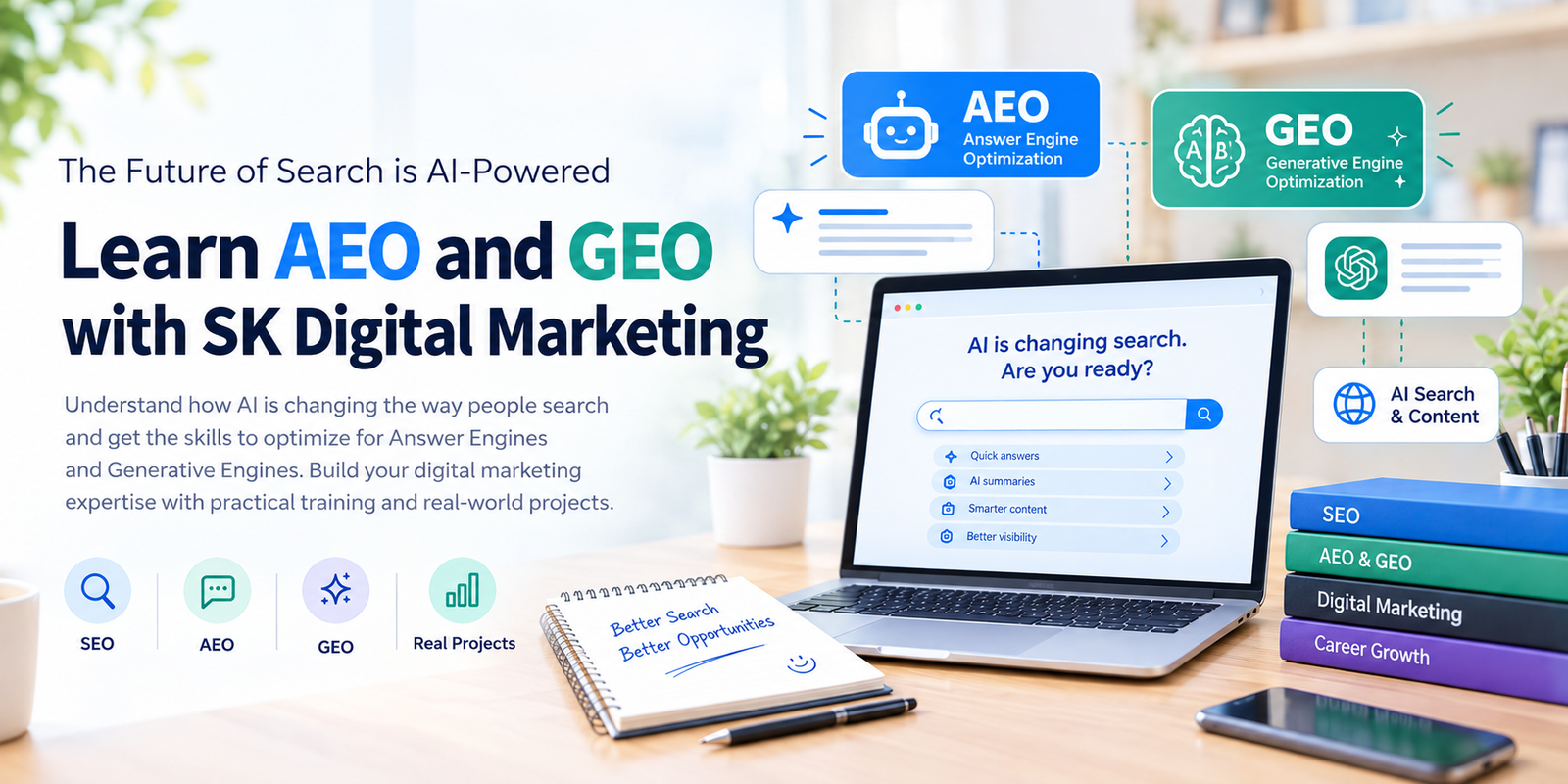
Search is changing. People are no longer relying only on traditional search engine results to find information. They are increasingly using AI-powered platforms such as ChatGPT, Google AI features, Microsoft Copilot, and Perplexity to ask questions, compare options, and discover businesses.
This shift has introduced two important digital marketing concepts: Answer Engine Optimization (AEO) and Generative Engine Optimization (GEO).
If you are planning to learn digital marketing, understanding AEO and GEO can help you develop skills for the changing search landscape. But what exactly do you study when AEO and GEO are included in a digital marketing course?
Let’s explore the key topics, practical skills, tools, and strategies you can learn.
What Are AEO and GEO?
What is AEO?
Answer Engine Optimization (AEO) focuses on creating and optimizing content so that it can provide direct answers to users’ questions.
Traditional SEO often focuses on ranking webpages in search results. AEO goes a step further by structuring information in a way that makes it easier for search engines and answer engines to understand and extract useful answers.
For example, instead of searching:
“best digital marketing course”
a user might ask:
“What should I learn in a digital marketing course?”
Content optimized for AEO should provide a clear, direct, and useful answer.
What is GEO?
Generative Engine Optimization (GEO) focuses on improving the visibility and representation of a brand or website in AI-generated search responses.
AI platforms analyze information from multiple sources and generate responses based on the information they find. GEO involves creating trustworthy, well-structured, relevant content that AI systems can understand and potentially reference.
AEO and GEO are closely related to SEO but focus more heavily on answers, context, entities, structured information, and AI-driven search experiences.
Why Should Digital Marketing Students Learn AEO and GEO?
Digital marketing is continuously evolving. SEO is still an important skill, but marketers also need to understand how users discover information through AI-powered search.
Learning AEO and GEO can help students understand:
- How people search using conversational queries
- How AI systems interpret online content
- How to create answer-focused content
- How to structure webpages for better understanding
- How entities and topics influence search visibility
- How FAQs can support answer-focused content
- How to measure visibility across different search experiences
- How traditional SEO and AI search optimization can work together
The goal is not to replace SEO with AEO or GEO. Instead, students can learn how these approaches complement traditional SEO.
What Will You Study in AEO and GEO Training?
A practical digital marketing course that includes AEO and GEO may cover several important areas.
1. Understanding AI-Powered Search
The first step is understanding how modern search is changing.
Students can learn about:
- AI-generated search answers
- Conversational search
- Large language models
- AI search platforms
- Search intent
- Question-based searches
- Traditional search vs AI search
This foundation helps students understand why content needs to be useful not only for search engines but also for people and AI-driven experiences.
2. Understanding Search Intent
Search intent is an important part of SEO, AEO, and GEO.
Students can learn how to identify whether someone is looking for:
- Information
- A specific website or brand
- A product or service
- A comparison
- A solution to a problem
For AEO, understanding the exact question behind a search is especially important.
For example:
Query: “How long does SEO take to show results?”
A useful AEO-focused page should answer the question directly before providing additional details.
3. Keyword and Question Research
AEO introduces a stronger focus on questions and conversational searches.
Students can learn how to research:
- Question-based keywords
- Long-tail keywords
- Conversational queries
- “How,” “what,” “why,” and “when” searches
- People Also Ask questions
- Related searches
- Topic-based search terms
This research can then be used to create content that answers the questions users are actually asking.
4. Creating Answer-Focused Content
Students can learn how to write content that provides clear answers without unnecessary complexity.
A good AEO-focused answer generally needs to be:
- Direct
- Relevant
- Accurate
- Easy to understand
- Well structured
- Supported by useful context
For example, instead of hiding the answer deep inside a long paragraph, a blog can answer the main question in the opening section and then explain the topic in greater detail.
5. Optimizing FAQs for AEO
FAQs can be an important part of an answer-focused content strategy.
Students can learn how to:
- Find relevant questions
- Create useful FAQ sections
- Write concise answers
- Avoid repetitive questions
- Connect FAQs with search intent
- Use FAQs to cover related user queries
For example, a digital marketing course page could answer questions such as:
What is included in a digital marketing course?
Is SEO included in digital marketing training?
Can beginners learn digital marketing?
What tools are used in digital marketing?
These questions can address the information users need before choosing a course.
6. Content Structuring for AI Search
GEO and AEO require marketers to think carefully about how information is presented.
Students can learn how to organize content using:
- Clear headings
- Short paragraphs
- Lists
- Tables where appropriate
- Definitions
- Step-by-step explanations
- FAQs
- Relevant internal links
- Supporting evidence and references
Well-structured content makes it easier for both users and automated systems to understand the relationships between different pieces of information.
7. Entity and Topic Optimization
GEO goes beyond individual keywords.
Students can learn about entities, topics, relationships, and context.
For example, a page about digital marketing training should clearly establish relationships between concepts such as:
Digital Marketing → SEO → AEO → GEO → Content Marketing → Google Ads → Social Media Marketing
Building strong topical relationships can help search systems better understand what a website is about.
8. Building Topical Authority
Another important skill is learning how to build content around a complete topic instead of publishing unrelated articles.
For example, a website teaching digital marketing could create a content cluster around AEO:
- What is AEO?
- AEO vs SEO
- How to implement AEO
- AEO keyword research
- How to optimize FAQs for AEO
- AEO tools
- AEO content strategy
- AEO mistakes to avoid
These articles can be internally linked to create a stronger topical structure.
9. Understanding Schema Markup
Students can also learn how structured data works and where it can be useful.
Topics may include:
- Schema markup basics
- Organization schema
- Article schema
- FAQ-related structured data
- Course schema
- Local business schema
- Understanding structured information
Schema should not be treated as a shortcut to AI visibility. Instead, students should understand it as one part of a broader technical and content strategy.
10. Measuring AEO and GEO Performance
A modern digital marketing course should also teach students how to analyze results.
Students can learn to monitor:
- Organic search traffic
- Search impressions
- Click-through rates
- Keyword rankings
- Question-based queries
- Featured-result visibility
- Brand mentions
- Referral traffic
- AI search visibility
Because AI search is evolving quickly, measurement can be more complex than simply checking a traditional keyword ranking.
What Tools Can You Learn for AEO and GEO?
A practical training program can introduce students to different tools used for research, content development, SEO, and analysis.
Depending on the course curriculum, students may work with tools such as:
- Google Search Console
- Google Analytics
- Google Keyword Planner
- Google Trends
- Semrush
- Ahrefs
- Screaming Frog
- ChatGPT
- Perplexity
- Other AI and content research tools
The important part is not simply learning the names of these tools. Students should learn when and why to use each tool.
How AEO and GEO Fit Into a Digital Marketing Course
AEO and GEO should not be studied separately from the rest of digital marketing.
A complete learning path can look like:
Digital Marketing Fundamentals → SEO → Keyword Research → Content Marketing → Technical SEO → AEO → GEO → Analytics → Practical Projects
This approach helps students understand how different marketing channels work together.
For example, SEO can help a website improve its organic visibility, while AEO-focused content can address specific questions and GEO strategies can help prepare content for AI-driven search experiences.
Can Beginners Learn AEO and GEO?
Yes. Beginners do not necessarily need to be advanced SEO professionals before starting to learn AEO and GEO.
However, having a foundation in digital marketing and SEO can make the concepts easier to understand.
A beginner can start with:
- Digital marketing fundamentals
- Search engine basics
- Keyword research
- Search intent
- Content writing
- SEO fundamentals
- AEO
- GEO
- Analytics and reporting
- Practical projects
Learning through practical assignments can also help students understand how these concepts are applied to real websites.
What Practical Projects Can Students Work On?
Theory alone is not enough for digital marketing.
Students can practice AEO and GEO by working on projects such as:
- Finding question-based keywords for a website
- Creating an AEO-friendly blog
- Building an FAQ section
- Optimizing an existing webpage
- Creating an AEO content cluster
- Developing a GEO-focused content strategy
- Improving internal linking
- Auditing website content
- Analyzing search performance
- Comparing traditional SEO and AI search visibility
Practical projects can help students understand how strategies are implemented on real websites.
Learn AEO and GEO at SK Digital Marketing
If you want to learn AEO and GEO as part of your digital marketing education, SK Digital Marketing provides digital marketing training that covers modern search optimization techniques, including AEO and GEO.
The training is designed to help students understand how search is changing with AI and how digital marketers can adapt their SEO and content strategies accordingly.
As part of the learning process, students can explore topics such as:
- SEO fundamentals and advanced SEO
- Keyword and search-intent research
- Content optimization
- Answer Engine Optimization (AEO)
- Generative Engine Optimization (GEO)
- AI-powered search and content strategies
- Technical SEO and website optimization
- Schema and structured data
- Local SEO
- Google Analytics and Search Console
- AI tools for digital marketing
- Practical SEO, AEO and GEO projects
Learn AEO and GEO With Practical Digital Marketing Training
AEO and GEO work alongside SEO rather than replacing it. By learning these concepts as part of a broader digital marketing course, students can understand how keyword research, content creation, technical optimization, search intent, and AI search experiences connect with each other.
At SK Digital Marketing, students can learn these concepts through practical digital marketing training and apply their knowledge to real website and content optimization activities.
Whether you are a beginner starting your digital marketing journey or an existing marketer looking to understand AI-driven search, learning SEO, AEO, and GEO together can help you build a more complete understanding of modern search marketing.
Want to learn AEO and GEO along with complete digital marketing skills? Explore the digital marketing course at SK Digital Marketing and start building practical skills for the changing search landscape.
Frequently Asked Questions
What is AEO in digital marketing?
AEO stands for Answer Engine Optimization. It focuses on creating and structuring content so that it can provide clear, relevant answers to users’ questions across search and answer-focused platforms.
What is GEO in digital marketing?
GEO stands for Generative Engine Optimization. It focuses on optimizing content and brand information for visibility and understanding within AI-powered generative search experiences.
Can I learn AEO and GEO as a beginner?
Yes. Beginners can learn AEO and GEO by first understanding digital marketing and SEO fundamentals, followed by search intent, content optimization, AI search, and practical implementation.
Is AEO the same as SEO?
No. AEO and SEO overlap, but they have different focuses. SEO broadly focuses on improving website visibility in search engines, while AEO places greater emphasis on providing direct answers to user questions.
Why should digital marketing students learn GEO?
GEO helps students understand how content and brands may be discovered and represented in AI-generated search experiences. It adds another skill to traditional SEO and content marketing knowledge.
What skills are required for AEO and GEO?
Important skills include SEO fundamentals, keyword research, search intent analysis, content writing, technical SEO, structured data, entity understanding, content strategy, analytics, and familiarity with AI-powered search.
Is AEO and GEO training useful for a digital marketing career?
AEO and GEO can complement traditional SEO, content marketing, and digital marketing skills. Learning these emerging areas can help students understand the changing search environment and develop broader search optimization knowledge.