
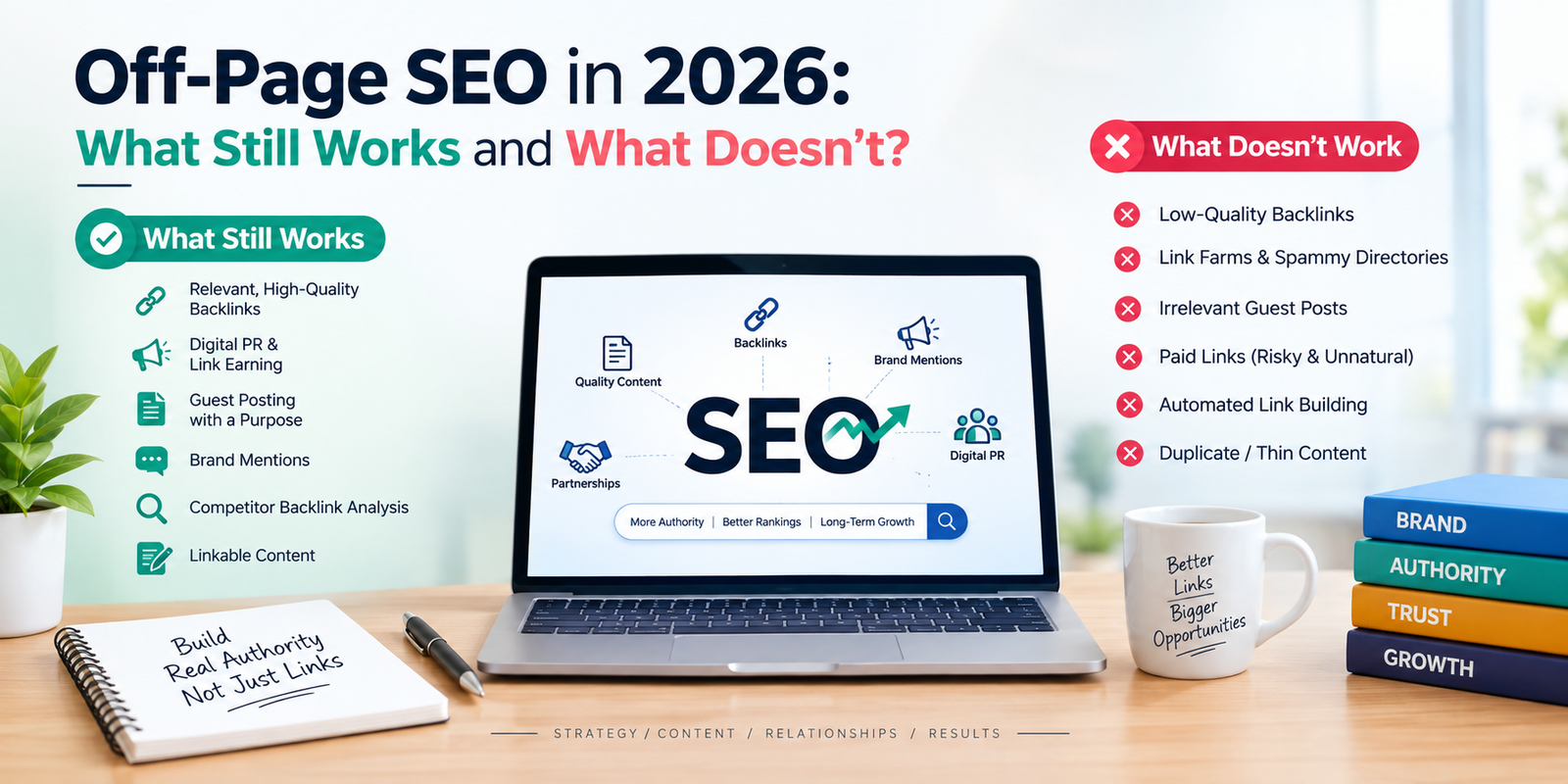
SEO is no longer just about adding keywords to web pages and building as many backlinks as possible. In 2026, search engines are becoming better at understanding relevance, authority, context, brand reputation, and the overall value of a website.
This has changed the way marketers approach off-page SEO.
Some traditional techniques are still useful when done properly, while others can waste time or even create risks for a website. The focus has moved from simply building links to building genuine authority and earning mentions from relevant sources.
So, what actually works for off-page SEO in 2026, and which strategies should you avoid?
Let’s look at the current approach.
What Is Off-Page SEO?
Off-page SEO refers to activities performed outside your own website to improve its visibility, authority, reputation, and ability to rank in search results.
Backlinks are an important part of off-page SEO, but they are not the only factor.
Modern off-page activities can include:
- Earning backlinks from relevant websites
- Digital PR
- Brand mentions
- Guest contributions
- Online business citations
- Competitor backlink research
- Digital partnerships
- Industry publications
- Reviews and reputation building
- Creating content that naturally attracts references
The main objective is to show that your website and brand are useful and trusted beyond your own website.
What Still Works for Off-Page SEO in 2026?
1. Relevant, High-Quality Backlinks
Backlinks continue to be an important part of SEO, but the quality and relevance of a link matter more than simply increasing the number of referring domains.
For example, a backlink to a digital marketing training website from a relevant marketing, business, education, or technology publication can be more meaningful than dozens of unrelated links.
When evaluating a potential backlink, consider:
- Is the website relevant to your industry?
- Does the linking page provide useful context?
- Is the website a genuine publication or business?
- Would the link be useful to its readers?
- Is the link placed naturally within the content?
The goal should be to build a relevant and natural backlink profile, not just a large one.
2. Digital PR and Link Earning
Digital PR is becoming an increasingly useful part of off-page SEO.
Instead of directly asking hundreds of websites for links, brands can create something worth talking about.
For example, a company could publish:
- Original research
- Industry surveys
- Useful statistics
- Expert insights
- Data studies
- Original reports
- Interesting case studies
Journalists, bloggers, and industry websites may then reference that information in their own content.
This approach can generate both brand visibility and valuable backlinks.
3. Guest Posting With a Purpose
Guest posting has not completely disappeared.
However, publishing low-quality articles on unrelated websites simply to obtain backlinks is not a strong long-term strategy.
A better approach is to contribute genuinely useful content to websites that have a clear connection with your industry.
For example, a digital marketing professional could contribute an article about SEO trends to a marketing publication or business website.
The purpose should be:
Relevant audience + useful content + genuine expertise
rather than:
Article + backlink = ranking
4. Brand Mentions
Your brand can be discussed online even when another website doesn’t link to you.
These brand mentions can help increase awareness and create opportunities for further promotion.
For example, someone may write:
“SK Digital Marketing offers digital marketing training for students and professionals.”
Even without a hyperlink, this creates a reference to the brand.
You can monitor relevant mentions and, where appropriate, contact publishers to see whether a useful source link can be added.
5. Competitor Backlink Analysis
Your competitors can provide useful information about potential link opportunities.
Tools such as Ahrefs, Semrush, and other SEO platforms can help identify websites linking to competing businesses.
You can then investigate:
- Which websites are linking to competitors?
- Why did they link?
- What type of content attracted the link?
- Is there an opportunity to create something more useful?
- Can your brand contribute something genuinely valuable?
The objective isn’t to copy every backlink your competitor has.
Instead, use competitor analysis to discover relevant opportunities.
6. Linkable Content
One of the best ways to earn backlinks is to create content that people naturally want to reference.
Examples include:
- Original statistics
- Detailed guides
- Industry reports
- Free tools
- Checklists
- Templates
- Case studies
- Research-based articles
- Original graphics and data
For example, instead of writing another generic article about “SEO Tips,” you could publish a detailed SEO Checklist for New Websites that marketers can reference when explaining SEO processes.
Useful resources have a better chance of attracting natural links.
7. Local Citations and Reputation
For businesses targeting specific locations, local citations and reputation management can still be important.
Business information should be accurate and consistent across relevant platforms.
Depending on the business, this can include:
- Business directories
- Industry-specific directories
- Local business websites
- Review platforms
- Professional associations
- Local publications
However, submitting your website to hundreds of random directories isn’t the goal.
Focus on relevant and trustworthy platforms.
What Doesn’t Work Well in 2026?
1. Buying Large Numbers of Low-Quality Backlinks
Buying hundreds or thousands of backlinks from questionable websites may look attractive because it can increase link counts quickly.
But link quantity alone doesn’t create authority.
Links from irrelevant, low-quality, or spammy websites can provide little value and may create an unnatural backlink profile.
SEO should focus on earning meaningful references rather than purchasing large volumes of links.
2. Automated Link Building
Automated tools that create backlinks across blogs, forums, directories, comments, or other websites are not a sustainable SEO strategy.
These systems often produce:
- Irrelevant links
- Duplicate content
- Spammy comments
- Poor-quality directories
- Unnatural anchor text
- Large numbers of low-value links
Automation can be useful for research and analysis, but blindly generating backlinks is a different matter.
3. Comment Spam
Leaving comments on hundreds of blogs simply to place a website link is an outdated approach.
For example:
“Great article! Visit our website for the best SEO services.”
Repeated comments like this don’t provide meaningful value to readers.
If you participate in an industry discussion, the contribution should be useful even without the link.
4. Excessive Exact-Match Anchor Text
Anchor text is the clickable text used for a hyperlink.
Suppose your target keyword is:
digital marketing course in Panchkula
Building large numbers of backlinks with exactly the same anchor text can look unnatural.
A more natural backlink profile may contain different types of anchor text, including:
- Brand name
- Website URL
- Natural phrases
- Partial-match phrases
- Generic references
- Relevant keywords where appropriate
The focus should be on natural linking rather than forcing keywords into every backlink.
5. Irrelevant Guest Posts
Publishing articles on completely unrelated websites just because they offer backlinks is another strategy to avoid.
For example, a digital marketing website doesn’t necessarily need backlinks from unrelated websites about completely different industries.
Relevance matters.
A smaller but highly relevant opportunity may be more useful than a large number of unrelated placements.
6. Private Blog Networks Used Solely for Manipulation
Private blog networks, or PBNs, are networks of websites created or controlled primarily to manipulate search rankings through backlinks.
Although these networks may appear powerful on the surface, they carry significant risks when used to manipulate rankings.
Building genuine authority through real publications, partnerships, PR, and useful content is a more sustainable approach.
How Should You Approach Off-Page SEO in 2026?
A modern off-page SEO strategy can be divided into five simple stages.
Step 1: Research Your Competitors
Identify competitors that rank for your target topics.
Study their backlink profiles and look for patterns.
Step 2: Find Relevant Opportunities
Look for:
- Industry publications
- Local websites
- Relevant blogs
- Business associations
- News websites
- Resource pages
- Podcast opportunities
- Partnership opportunities
Step 3: Create Something Worth Referencing
Don’t start with:
“Where can I get a backlink?”
Start with:
“What can I create that another website would genuinely want to reference?”
This change in mindset can improve your entire link-building strategy.
Step 4: Promote Your Content
Creating great content isn’t enough.
Promote it through:
- Email outreach
- Social media
- Digital PR
- Industry communities
- Professional networks
- Relevant partnerships
Step 5: Monitor Your Backlink Profile
Regularly review your backlinks to understand:
- New referring domains
- Lost backlinks
- Relevant links
- Suspicious patterns
- Competitor link opportunities
- Changes in your backlink profile
This helps you understand whether your off-page strategy is actually producing useful results.
Off-Page SEO in 2026: Quality Over Quantity
The biggest change in off-page SEO is the shift from link quantity to overall authority and relevance.
Getting 1,000 backlinks isn’t automatically better than getting 20 relevant links.
Consider two scenarios.
Website A gets hundreds of links from unrelated websites with little connection to its industry.
Website B earns links from relevant publications, industry resources, local organizations, and websites that genuinely reference its content.
The number of links alone doesn’t tell the complete story.
A sustainable SEO strategy focuses on building a reputation that exists beyond your own website.
Final Thoughts
Off-page SEO is still important in 2026, but the strategy has evolved.
Instead of focusing only on directory submissions, automated backlinks, and large quantities of links, businesses should concentrate on relevance, useful content, digital PR, brand visibility, genuine relationships, and authoritative references.
The question is no longer simply:
“How many backlinks can we build?”
A better question is:
“Why would another credible website want to mention or recommend our brand?”
When your content, expertise, and brand provide genuine value, off-page SEO becomes more than a link-building exercise. It becomes a way to build long-term online authority.