
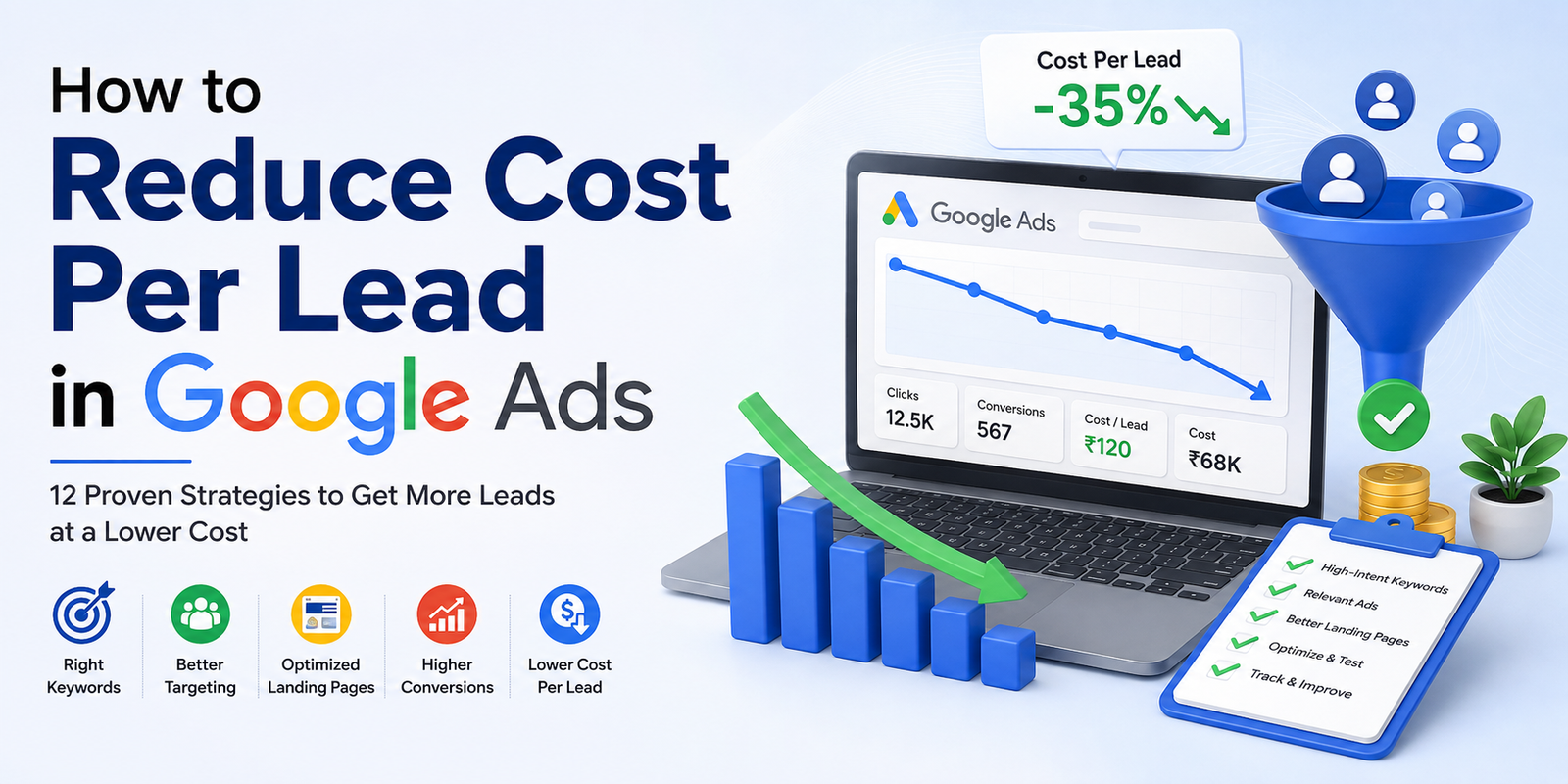
Google Ads can be one of the most effective ways to generate targeted leads for a business. However, simply running paid campaigns does not guarantee profitable results. If you are spending a significant amount on advertising but receiving fewer leads, your cost per lead (CPL) may be too high.
Reducing the cost per lead in Google Ads is not just about lowering your advertising budget. It requires a combination of better keyword targeting, relevant ad copy, optimized landing pages, accurate conversion tracking, and continuous campaign optimization.
In this guide, we will explore practical ways to reduce cost per lead in Google Ads while maintaining lead quality and improving your overall advertising performance.
What Is Cost Per Lead in Google Ads?
Cost per lead is the average amount you spend on Google Ads to generate one lead.
The basic formula is:
Cost Per Lead = Total Google Ads Spend ÷ Number of Leads Generated
For example, if you spend ₹50,000 on Google Ads and generate 100 leads:
₹50,000 ÷ 100 = ₹500 per lead
A lower CPL can improve your return on advertising spend, but remember that the cheapest lead is not always the best lead. Your primary goal should be to generate qualified leads at a sustainable cost.
Why Is Your Google Ads Cost Per Lead High?
Several factors can contribute to a high CPL, including:
- Targeting highly competitive keywords
- Using broad or irrelevant keywords
- Poor-quality ad copy
- Low landing page conversion rates
- Incorrect conversion tracking
- Poor audience targeting
- High cost per click
- Weak offers or calls to action
- Irrelevant search terms
- Focusing on lead quantity instead of lead quality
The good news is that many of these factors can be improved through proper campaign optimization.
12 Ways to Reduce Cost Per Lead in Google Ads
1. Choose High-Intent Keywords
Keyword selection is one of the most important factors affecting Google Ads performance.
Instead of targeting only broad keywords with high search volume, focus on keywords that demonstrate strong commercial or transactional intent.
For example, a business offering digital marketing training might target:
Lower intent:
“digital marketing”
Higher intent:
“digital marketing course in Panchkula”
The second search indicates that the user is more likely to be looking for a specific course or service.
Use keyword research to identify terms that are relevant to your offering and closely connected to your customers’ purchasing intent.
2. Use Negative Keywords
Negative keywords help prevent your ads from appearing for searches that are irrelevant to your business.
For example, if you offer paid digital marketing courses, you may want to review searches containing terms such as:
- Free
- Jobs
- Salary
- Tutorial
- Definition
- Download
The exact negative keywords will depend on your business and campaign objectives.
Regularly check your Search Terms Report to identify irrelevant searches and add appropriate negative keywords.
This can reduce wasted clicks and help your budget focus on users who are more likely to become leads.
3. Improve Your Ad Relevance
Your advertisement should closely match the keyword and search intent.
If someone searches for “Google Ads course in Panchkula,” your advertisement should clearly communicate that you offer a Google Ads course in Panchkula.
A relevant ad can help attract more qualified clicks and improve the overall user experience.
Try to include important elements such as:
- Primary keyword
- Main benefit
- Location, where relevant
- Unique selling point
- Call to action
For example:
Learn Google Ads in Panchkula
Practical Training | Expert Mentors | Certification
Join Today
Avoid writing generic advertisements that could apply to almost any business.
4. Optimize Your Landing Page
Getting clicks is only one part of Google Ads success. Your landing page needs to convert those visitors into leads.
A poorly designed landing page can result in high advertising costs even when your ads are performing well.
Your landing page should include:
- A clear and relevant headline
- A strong value proposition
- Simple navigation
- One primary call to action
- Short and easy-to-complete forms
- Customer reviews or testimonials
- Trust signals
- Relevant images or visuals
- Mobile-friendly design
- Fast loading speed
The message on your landing page should also match the promise made in your advertisement.
For example, if your ad promotes a “Digital Marketing Course in Panchkula,” the landing page should immediately explain that course rather than sending visitors to a generic homepage.
5. Improve Your Conversion Rate
Conversion rate has a direct relationship with your cost per lead.
Suppose you receive 1,000 clicks at ₹50 per click.
Your total spend is:
1,000 × ₹50 = ₹50,000
If only 50 visitors become leads:
₹50,000 ÷ 50 = ₹1,000 CPL
Now suppose you improve your landing page and generate 100 leads from the same 1,000 clicks:
₹50,000 ÷ 100 = ₹500 CPL
You have reduced your CPL without reducing your advertising spend.
This is why improving conversion rate can be more effective than simply trying to reduce your bids.
6. Track the Right Conversions
Accurate conversion tracking is essential for Google Ads optimization.
Your campaign should distinguish between meaningful actions and less valuable interactions.
Depending on your business, conversions may include:
- Lead form submissions
- Phone calls
- WhatsApp enquiries
- Appointment bookings
- Demo requests
- Course enquiries
- Purchases
If your tracking is incorrect, Google Ads may optimize toward actions that do not actually contribute to your business.
Make sure your conversion setup reflects the actions that matter most to your business.
7. Focus on Qualified Leads Instead of Just More Leads
A low CPL does not necessarily mean a successful campaign.
Imagine two campaigns:
Campaign A
- Spend: ₹30,000
- Leads: 100
- CPL: ₹300
- Qualified leads: 10
Campaign B
- Spend: ₹30,000
- Leads: 60
- CPL: ₹500
- Qualified leads: 25
Although Campaign A has the lower CPL, Campaign B may deliver significantly better business results.
Therefore, track lead quality alongside CPL.
If possible, connect your CRM or sales data with your advertising strategy so you can understand which campaigns, keywords and audiences generate actual customers.
8. Use the Right Google Ads Bidding Strategy
Google Ads provides automated bidding strategies that can help advertisers optimize campaigns toward specific goals.
For lead-generation campaigns, conversion-focused strategies such as Maximize Conversions or Target CPA may be appropriate depending on your campaign data, goals and account setup.
However, automated bidding should not be treated as a replacement for campaign management.
Before relying heavily on automated bidding, make sure that:
- Conversion tracking is accurate
- Your conversion actions are meaningful
- Your campaigns have sufficient data
- Your targeting is relevant
- Your landing pages are effective
Automation works best when it has reliable data to work with.
9. Optimize Location Targeting
If your business serves specific locations, avoid spending your budget on users outside your service area.
For example, a local business serving Panchkula may want to focus its campaigns on relevant areas around Panchkula, Chandigarh, Mohali and Zirakpur, depending on its actual target market.
Review location performance regularly.
You may find that one location generates:
- Lower CPL
- Higher conversion rates
- Better-quality leads
While another location produces expensive clicks and poor-quality enquiries.
Use this data to make smarter budget allocation decisions.
10. Analyze Device Performance
Your customers may behave differently on mobile, desktop and tablet devices.
Check your campaign performance by device and compare:
- Click-through rate
- Cost per click
- Conversion rate
- Cost per lead
- Lead quality
If mobile generates a large percentage of your traffic but has a poor conversion rate, investigate the mobile experience.
Your landing page should be easy to use on smaller screens, with readable text, fast loading and a clear CTA.
11. Test Different Ads and Landing Pages
Testing is one of the most effective ways to improve Google Ads performance.
You can test different:
- Headlines
- Descriptions
- Offers
- Calls to action
- Landing page headlines
- Form lengths
- Trust elements
- Benefits
For example, one landing page might promote:
“Learn Digital Marketing From Industry Experts”
while another focuses on:
“Build Job-Ready Digital Marketing Skills”
Track which message generates more qualified leads.
Avoid changing everything at once. Make controlled improvements so you can understand which changes are actually making a difference.
12. Regularly Review Search Terms and Campaign Data
Google Ads optimization is not a one-time activity.
Set a regular schedule to review your campaign performance.
Look at:
- Search terms
- Keywords
- Click-through rate
- Cost per click
- Conversion rate
- Cost per lead
- Location performance
- Device performance
- Ad performance
- Landing page performance
- Lead quality
Remove or improve elements that consistently waste budget and invest more in campaigns, keywords and audiences that generate valuable leads.
How to Calculate Your Target Cost Per Lead
Before trying to reduce your CPL, understand how much you can realistically afford to pay for a lead.
For example, suppose:
- Average customer value = ₹20,000
- Desired marketing cost per customer = ₹4,000
- Lead-to-customer conversion rate = 10%
If 10 leads generate one customer, a ₹400 CPL would result in approximately ₹4,000 acquisition cost per customer.
This gives you a practical benchmark for evaluating campaign performance.
Your ideal CPL will vary depending on your industry, margins, sales process and customer lifetime value.
Common Mistakes That Increase Google Ads CPL
Avoid these common mistakes:
Targeting Too Broadly
Broad targeting can generate a high volume of irrelevant clicks.
Sending All Traffic to the Homepage
A dedicated landing page is often more relevant than a generic homepage for lead-generation campaigns.
Ignoring Negative Keywords
Without regular search-term analysis, your budget may be spent on irrelevant searches.
Tracking Every Interaction as a Conversion
Not every click or engagement represents a valuable business lead.
Optimizing Only for Low CPL
A low CPL with poor-quality leads can be worse than a slightly higher CPL with highly qualified prospects.
Making Changes Too Frequently
Constantly changing campaign settings can make it difficult to understand what is working.
Google Ads CPL Optimization Checklist
Before increasing your Google Ads budget, review the following:
- Are you targeting high-intent keywords?
- Have you added relevant negative keywords?
- Does your ad match the user’s search?
- Is your landing page relevant?
- Is your website mobile-friendly?
- Is conversion tracking working correctly?
- Are you measuring qualified leads?
- Are you reviewing search terms regularly?
- Are you analyzing location and device performance?
- Are you testing your ads?
- Are you monitoring conversion rates?
- Are you comparing CPL with actual customer value?
If several answers are “no,” there may be significant opportunities to improve your campaign performance.
Final Thoughts
Reducing the cost per lead in Google Ads is not simply about spending less money. The real objective is to make every advertising rupee work more efficiently.
Start with accurate conversion tracking, target high-intent keywords, use negative keywords, improve your ad relevance and optimize your landing pages. Then analyze lead quality, test different strategies and continuously review campaign data.
Most importantly, don’t judge a Google Ads campaign only by its CPL. A campaign that generates fewer but higher-quality leads can deliver much better results than one that produces hundreds of inexpensive but irrelevant enquiries.
With the right strategy and consistent optimization, businesses can improve their conversion rates, reduce wasted ad spend and build a more profitable Google Ads campaign.